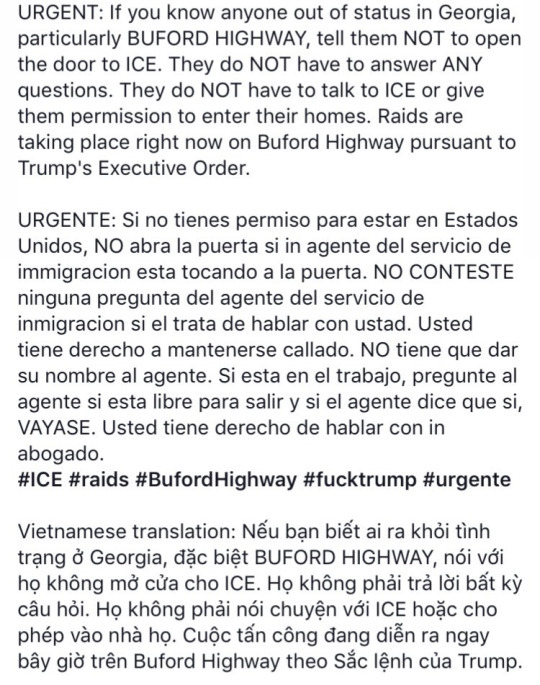
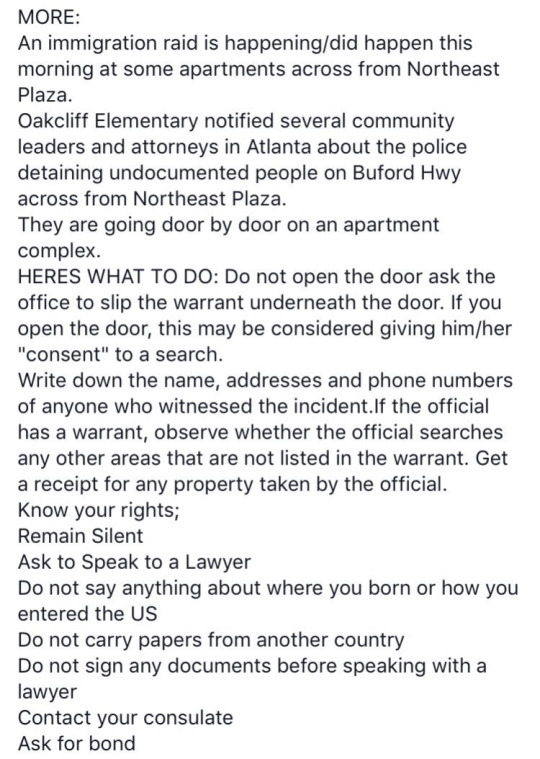
Here’s some more info on what’s happening in Georgia
I told you the Muslims were the first step. They’re coming after Latinos with no criminal records in their own homes now. Three minutes from my house they detained over 100 people yesterday and literally dragged them out of their houses. They are pulling drivers over on the streets asking for papers. They are following school buses home and arresting parents when they meet the children at the stops. They’re not releasing the names of anyone they have apprehended. They’re not answering any questions from journalists/CHIRLA/the public or giving reasons as to why they’re detaining people without access to immigration attorneys. ICE has gone rogue and it seems to be in retaliation for the 9th circuit ruling against the Muslim Ban. It was clear that the Justice Department was losing during arguments on Tuesday and about 24 hours later random raids all across the country started happening? Not a coincidence.
Meanwhile on Twitter, Republicans are challenging each other to see who can report more “illegal looking people” to the ICE tip line. There are accounts proudly boasting their report tallies and encouraging more to follow suit. Others are saying they reported their neighbors or friends of friends. Any resemblance to Nazi Germany is not unintentional. Be safe out there. We’ve waded into very dangerous territory.
Anna who was born free, met a Frederick when he slave, she sold many of her belongings to money to help him escape and then moved to NYC with him where they got married. When he started touring with and working with white abolitionists, he started treating her like shit because she was illiterate. (He didn’t have any problem taking money from her to escape tho.)
Then homeboy got bold as hell and moved in a white woman in his wife’s house. Then the first white moves out and he moves another white woman who stayed there for months at a time for 20 fucking years. After Anna died when married a white woman a year later.
(b. c. 1813; d. 4 August 1882), the first wife of Frederick Douglass. The enigmatic first wife of Frederick Douglass, Anna Murray Douglass has been misunderstood and misrepresented by historians as well as by her husband’s associates since he first rose to fame in 1842. Her early life, including her birth and parentage, remain sparsely documented. Most historians agree that she was the daughter of Bambarra and Mary Murray, emancipated slaves from Denton in Caroline County, Maryland. As a young adult she lived in Baltimore, Maryland, working as a housekeeper and laundress in white homes. Despite refusing to demonstrate reading or writing skills throughout her life, she clearly had some interest in self-improvement in her youth because she first met Frederick Douglass, then known as Frederick Bailey, through mutual friends at the East Baltimore Mental Improvement Society, an organization of free blacks who promoted literacy.
The two had met by the late summer of 1838, when Anna sold many of her belongings to help Frederick purchase the train tickets for his escape. She also sewed the sailor uniform he wore as a disguise and accumulated the necessary items for starting a household. Once Frederick reached his destination in New York City, he wrote for her to join him. The Reverend James W. C. Pennington performed their marriage ceremony, and the young couple moved to New Bedford, Massachusetts, first using the last name of Johnson but soon changing it to Douglass.
The first years of the marriage appear to have been congenial. Anna bore four children—Rosetta, Lewis Henry, Charles Remond, and Frederick Douglass Jr.—during their residence in New Bedford. While Douglass searched for jobs on the city’s docks, Anna kept house on a small budget. When the family moved to Lynn, Massachusetts, she also took in piecework from the local shoe factories and saved everything that her husband sent to her while he toured for the American Anti-Slavery Society.
Strain began to manifest in the Douglass marriage once Frederick became involved in the abolitionist movement. He spent a good deal of time away from home giving lectures, including two years in Europe. Most of his white associates expressed disdain for his wife, at their most generous referring to Anna as a poor intellectual match for her husband, and treated her like a servant in her own home. They, like historians, have focused on Anna’s illiteracy and stoicism to bolster their arguments. Anna, however, had little time for intellectual pursuits while running a household and raising a family with little help from her husband.
By the late 1840s Anna lost much of her emotional support system. Her daughter, Rosetta, was away at school in Albany, New York; and her friend and household helper, Harriet Bailey, had married and moved to Springfield, Massachusetts. Meanwhile, her husband toured England, where rumors spread about the attention lavished on him by the English ladies. After his return in 1847 Douglass moved the family to Rochester, New York, taking Anna away from the small but active black community of which she had been a part in Lynn. Shortly thereafter she suffered the indignity of having the British reformer Julia Griffiths move into the Douglass home, which caused a storm of controversy alleging Frederick’s infidelity with Griffiths. The departure of Griffiths was followed by the arrival of Ottilie Assing, who installed herself in the Douglass home for several months out of the year over the next twenty years. For much of her life Anna lived isolated from supportive African American companionship while hosting a string of white abolitionists who could barely conceal their disdain for her. Only the extended stays of Rosetta and her children and the companionship of Louisa Sprague, Rosetta’s sister-in-law who lived in the Douglass home as a housekeeper, relieved Anna’s loneliness.
Nevertheless, Anna understood her husband’s role in fighting slavery and her role as his helpmate. She took pride in her husband’s appearance and accomplishments and in keeping a well-ordered home. She continued to take an active part in operation of the household, even after Douglass had become wealthy enough to hire servants. After Anna’s death her work was informally recognized by black women, who continued to refer to the home at Cedar Hill, Uniontown, D.C., as her home, and by Rosetta, who wrote a memoir of Anna’s life and named her eldest daughter Annie. Even Douglass’s second wife, Helen Pitts, did nothing to denigrate Anna’s memory during her own marriage and life at Cedar Hill.
Rosetta’s memoir, My Mother as I Recall Her, deserves particular attention as one of the only surviving documents about Anna Murray Douglass. Rosetta celebrated Anna’s work, placing her mother squarely within the nineteenth-century “cult of domesticity.” Rosetta used Anna as a symbol of the equality of black women within that sphere during an era in which black women were portrayed as either the sexually promiscuous “Jezebel” or the maternal caretaker “Mammy” of white families. On the other hand, not only did Anna actively support the end of slavery by aiding her husband’s flight to freedom and allowing him to pursue antislavery work but also she maintained an impeccable home and preserved her own dignity and that of her marriage in the face of white assault. In Rosetta’s narrative Anna emerges as a model of middle-class womanhood.
Douglass, for his part, recognized the role that Anna played in his life. During his first visit to England he maintained a cordial distance from his enthusiastic female admirers, and he defended his wife when anyone suggested that she was not a fit mate for him. After his return home in 1847 Anna conceived their last child, Annie, and Douglass risked his own arrest to reenter the United States to comfort Anna in the wake of that child’s death ten years later. When Anna died in 1882, he fell into a depression that he described as being the darkest moment of his life. Nevertheless, he seemed less than concerned for Anna’s feelings in bringing into their home two white women with whom he was rumored to be sexually involved. He also married a younger white woman within a year of Anna’s death, much to the chagrin of his family and both the black and white communities.
For much of her life, Anna suffered from various ailments, particularly headaches that made her ill. In her later years she suffered from a stroke that confined her to a wheelchair and her bedroom. In August 1882 she died shortly after having a second stroke.
It is our duty as feminists to protect and respect women in Hijabs
Now. More. Than. Ever.
Question: if I see someone pull off a Hijab, what should I do? I know there are reasons they are worn so I want to if i should stand in between them and who did this, should i protect them from view somehow, or something else? This has been happening a lot so I feel it’s something everyone needs to know.
Good question! I cannot correctly and effectively answer, as I am a white, non-Muslim person; however, I will reblog in case any of my followers can answer.
I asked my Hijabi friend, so here’s one Hijabi’s answer:
“my opinion is, definitely try cover them or give them something to cover themselves with. And perhaps shoo off the person, without putting oneself in danger! God forbid, if that happened to me, I would like someone to come and comfort me and give me something to cover my hair with and then help me report it to the cops
“
(Followers, if any of you are hijabi and would like to expand on this answer or offer alternatives, please do.)
If u see it happen to 1 of us, pls cover our head + hair with a coat or shawl or any piece of cloth, while hugging us in comfort. Please don’t get hurt by lashing out @ the perpetrators in any way, coz if they dare to do that, they’re probably too far gone in their own hatred to listen to any reason. Much love + Thank You to anyone who supports us.
yes !! everything said here is important af. if you see someone pull off a girl’s hijab immediately cover her hair and provide comfort. don’t talk to the perpetrator but try to get the woman out of there if you can. maybe if you have a scarf on you at the time give it to her so she can wear it until she’s alone and can replace her hijab. please please protect muslim girls because we already had it hard before donald trump became president and now its gonna be worse with people going around thinking their violence and cruelty is justified
for my other white ppl who might have a hard time, it’s my understanding that a hijab is like a major item of clothing, not an accessory like a hat or a scarf. so think abt it more like if someone just ripped someone’s shirt or skirt off. u don’t want to be left there exposed or have to walk home without it.
everyone, even outside America needs to protect our Muslim sisters in these times.
as a man, what would be the best thing to do? should i turn my head and avoid looking at their hair? can i still offer a jacket or something similar?
^I’m hoping someone has an answer islamaphpbia is on the rise in my town and I want to be a good male non Muslim ally
For men, yes please, we would prefer it if you avoided looking at our hair, and if we don’t have something to substitute as a hijab at that moment, anything you could lend us, a jacket, etc, would be very appreciated.
Also, since most girls avoid physical contact with men they’re not related to, please do not hug them, but rather shoo the offender away if you can, or at least escort the girl to a safe place. You can still offer words of encouragement and support. Furthermore, understand that the victim may not be very welcoming towards you because she’ll obviously be shaken, and won’t know where you are coming from. If that’s the case, please still give her something to cover herself (hijab is very important, think of it as someone ripping your shirt off) and stand some distance away until you are sure she’s in safe hands.
Thank you so much for your support, we really appreciate it, god bless all of you.
In the horrible climate we’re currently in, please take note of this.
Muslim writers, your stories are both needed and wanted. If you’re querying or planning on querying, @gildedspine has put together some tweets from agents who are seeking Muslim voices!




 tumbl backup